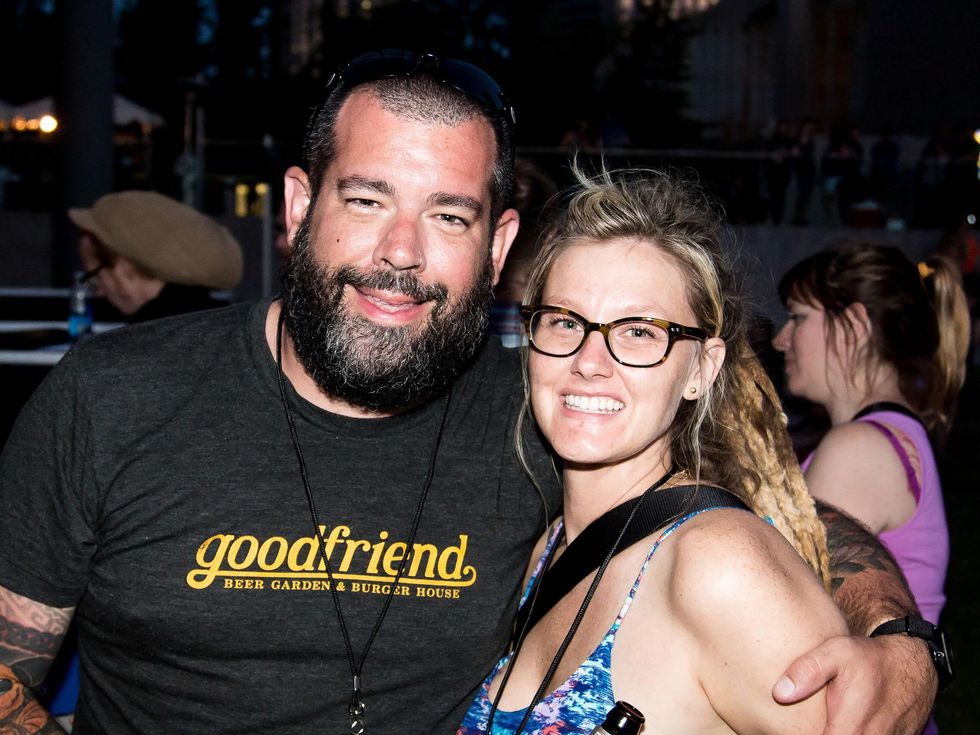
On April 17, the small town of West, Texas, was forever altered when a fertilizer plant exploded, killing more than a dozen and injuring so many more. Not surprisingly, however, through this tragedy we witnessed the powerful way in which a community — a country, really — unites to support those in need through emergency services, volunteer work and financial help.
Just 11 days after the tragedy, the citizens of Dallas descended on Annette Strauss Square to support their neighbors to the south at the Texans for West benefit concert. Hundreds of music enthusiasts sprawled out on the lawn at the AT&T Performing Arts Center to catch Jonathan Tyler & The Northern Lights, Toadies lead singer Vaden Todd Lewis, The O's, Somebody's Darling and Goodnight Ned — all of whom donated their time.
Credit goes to speedy event planners Matt Tobin, of Goodfriend Beer Garden & Burger House; Gavin Mulloy, of Granada Theater; Becki Howard,of AT&T Performing Arts Center; and major cash sponsor Regions Bank. The organizers also partnered with Communities Foundation of Texas (CFT) to create the Texans for West Fund. Concert proceeds will be deposited with CFT, which will distribute the money among nonprofits whose missions are to provide basic needs such as food, clothing, shelter and counseling services for those affected by the West disaster.
Spotted in the crowd of charitable concertgoers: Maxwell Smith, Nathan Yates, Katy Simmons, Sarah Hipp, Jeff Fryman, Billy Thomas, Zane Aveton, Rani Monson, Stephanie Bradshaw, Brandi Farris and Oliver Smith.
The career of actor Chris Hemsworth is a curious one, as it feels like he’s a huge star (mostly from playing Thor in Marvel movies) and not at the same time, with most of the non-MCU movies featuring him in a lead role failing to become big successes. But he still has a certain presence about him, which is why he’s being given another chance to prove his star power in the new thriller, Crime 101.
Hemsworth plays Davis, a talented thief who knows how to get what he wants without resorting to violence. When a job early in the movie turns slightly sideways, it makes him think twice about working with his handler (Nick Nolte), who seems to prefer someone with a stronger touch, like the up-and-coming Ormon (Barry Keoghan).
Davis is the main character, but two others who come into his orbit get their own subplots. Lou (Mark Ruffalo) is a slightly schlubby LAPD detective who’s convinced he knows the pattern of an unknown thief that likes to hit places close to Highway 101. Sharon (Halle Berry) works for a high-end insurance agency known for working with ultra-wealthy clients, the types who might be a great target for a thief like Davis.
Written and directed by Bart Layton, the film has a decent propulsion to it that comes with most crime thrillers. Davis and Ormon represent the yin and the yang of criminal approaches, and and it’s interesting to see the juxtaposition between the two as their simmering rivalry heats up over the course of the film. When the film commits to actually showing its crimes, it has an excitement that’s worth watching.
Unfortunately, Layton displays a real lack of focus, taking the audience into subplots with each of the three main characters that prove unnecessarily distracting. Lou’s marriage problems may explain his disheveled appearance, but there’s no need to see him deal with them with wife Angie (Jennifer Jason Leigh). Sharon’s troubles with her male-dominated company prove slightly pivotal, but still don’t merit the time put into exploring them.
The most baffling subplot is Davis pursuing a relationship with Maya (Monica Barbaro), a woman he randomly meets. At different points in the movie, including many of his interactions with Maya, Davis seems like the most uncomfortable, antisocial person in the world. And yet he somehow morphs into a suave smooth-talker who’s able to convince anyone to do what he wants at other key points, making it unclear exactly what kind of person he really is.
Hemsworth does relatively well in the lead role, but he’s still missing that certain something to make his character, and therefore the movie, truly compelling. The rest of the cast is fine, too, but each of them seem to be putting in just the minimal amount of effort to make the film watchable. Ruffalo and Barbaro come off the best, but with the talent in the cast (11 Oscar nominations and one win), they could have been used better.
Crime 101 has most of the ingredients to be another great entry in the genre, and it succeeds when it actually decides to deliver on its promise. But too much of the film is spent on things that have no real bearing on plot or character development, leaving the movie in the middle of the pack.