
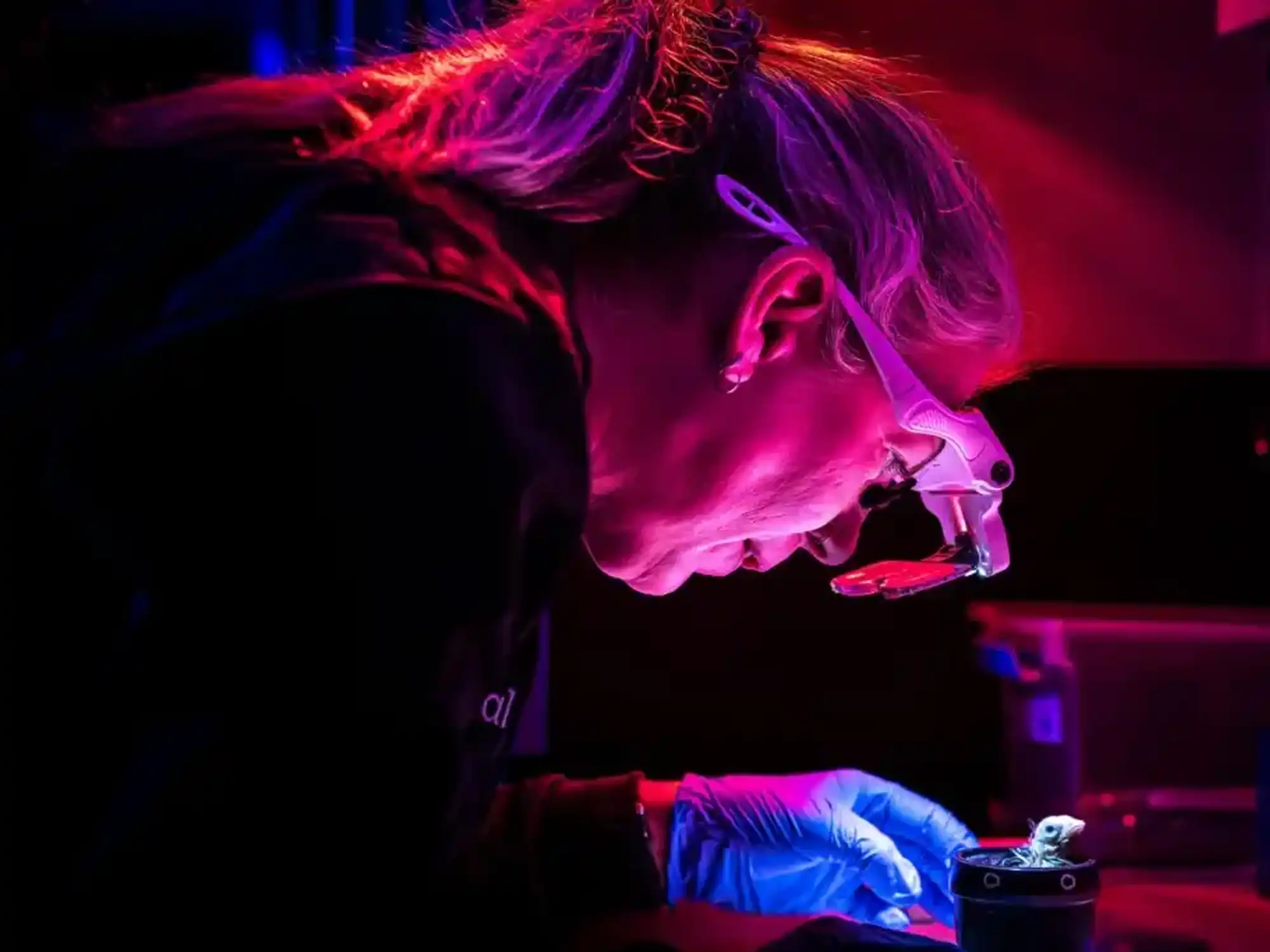
Some of the year’s most buzzworthy innovations have a North Texas connection. Eight inventions tied to Dallas-Fort Worth — including a phone that blocks nosy neighbors, a self-driving 18-wheeler, and a lab-made egg — have landed on Time magazine’s list of the 300 best inventions of 2026.
Here’s a look at the DFW-connected winners, starting with the ones you might find in your own home.
Samsung
Plano-based Samsung Electronics America pulled off a hat trick this year, with three products making Time’s list.
First up is the Galaxy S26 Ultra smartphone. It packs a more powerful camera, Galaxy AI features, and pro-level content creation tools. But Time singled out its new built-in privacy display as the phone’s “biggest selling point.” The feature dims the screen when viewed from an angle, making it “nearly impossible” for the person next to you on the plane to read your texts.
 Samsung's Galaxy S26 Ultra smartphone is recognized for its new built-in privacy display.Photo courtesy of Samsung Electronics America/PR Newswire
Samsung’s Bespoke AI Family Hub refrigerator also got smarter. When AI first came to the Family Hub in 2024, it could recognize some fresh foods, but you still had to log packaged items by hand, Time noted. Now, with Google Gemini built in, the fridge can identify more than 2,000 packaged foods, read handwritten labels, and warn you when food is about to expire. It then uses what’s inside to build grocery lists and suggest recipes, so that half-used jar of pesto might finally see the light of day.
And for gamers, there’s the Odyssey G8 monitor. Its 6K resolution leapfrogs the 4K standard, delivering what Samsung calls “exceptional visual clarity and detail” on a screen big enough for gaming and multitasking.
OxeFit
Plano-based OxeFit’s XS1 Peak is about the size of a treadmill but works like an entire gym. It can be set up for strength training, simulated skiing or kayaking, Pilates, or rowing.
What makes it stand out is a built-in virtual spotter. According to Time, the machine “uses AI, computer vision and sensors to correct the user’s form, change resistance in the middle of a rep and reduce the weight when the user is struggling, much like a human spotter.”
When the workout’s done, it folds up against the wall like a Murphy bed. Fair warning: The XS1 Peak retails for more than $6,000.
EssilorLuxottica
Parents of nearsighted kids, take note. EssilorLuxottica, the French eyewear giant whose U.S. headquarters is in Farmers Branch, makes Essilor Stellest lenses. The lenses correct nearsightedness while also slowing the eye growth that makes it worse over time.
Stellest is the first and only eyeglass lens authorized by the U.S. Food and Drug Administration to control myopia, Time said. The lenses look like regular glasses but contain 1,021 tiny lenslets. In a U.S. trial of kids ages 6-12, myopia progression slowed by an average of 71 percent over two years compared with standard lenses.
Helpany
If you have a parent or grandparent in senior living, this one may hit home.
Helpany, a startup based in Phoenix that manufactures its devices in DFW, makes Paul, a ceiling-mounted gadget that uses radar and AI to spot subtle changes in how residents move and flag those at higher risk of falling. Helpany says the technology can cut falls by as much as 72 percent.
Aurora Innovation
If you’ve driven I-45 between Dallas and Houston lately, you may have passed a big rig with no one behind the wheel. Last year, Aurora Innovation launched what it calls the country’s first driverless 18-wheeler delivery service on that route.
 Aurora Innovation's driverless 18-wheeler delivery service travels I-45, between Dallas and Houston. Photo courtesy of Aurora
Aurora, based in Pittsburgh with a corporate and operations hub in Coppell, rolled out its second-generation Driver 2 system in July. By September, Driver 2 trucks had logged more than 500,000 driverless miles without a single at-fault crash, Time reported, and the company expects 200 of them on the road by the end of 2026. A proprietary sensor lets the trucks see roughly 10 football fields ahead.
Without a human driver who needs rest, a Fort Worth-to-Phoenix run can take up to 40 percent less time, Time said. “It’s novel. It’s technically extraordinary,” Aurora co-founder and CEO Chris Urmson told Time. “And yet it’s all pretty boring.”
Aurora operates DFW trucking terminals in Aledo and Palmer.
Colossal Biosciences
The list’s most sci-fi DFW entry comes from Dallas-based Colossal Biosciences, the de-extinction company best known for efforts to revive the woolly mammoth and dire wolf.
Colossal built an artificial egg by placing an ultra-thin, transparent silicone membrane inside a rigid 3D-printed cup, letting scientists watch the embryo develop. Twenty-six chickens have already been hatched.
Andrew Pask, Colossal’s chief biology officer, told Time the invention could help critically endangered birds — New Zealand’s kākāpō, for example, a flightless parrot that struggles with low hatching rates.
Elsewhere in Texas
Two companies with ties to the Austin area and one Houston company also landed on the Time list. An Austin company also earned a spot on Time’s “Special Mentions” list.
Cedar Park-based Hyliion landed on Time’s list with its Karno Power Module, a modular generator designed to produce power wherever it’s needed.
The Karno represents a big pivot for the company. Hyliion got its start building electrified powertrains for 18-wheelers before shifting into power generation after acquiring the Karno generator technology from GE Aerospace. Founded in Pittsburgh in 2015, the company relocated to Cedar Park in 2018.
Hyliion recently won a $41.7 million contract from the Office of Naval Research to build 2- and 3-megawatt Karno systems, and trade publication Consulting-Specifying Engineer named the module its 2026 Most Valuable Product.
The other Austin-associated honoree is Moment Energy. As more electric vehicles hit the road, a growing number of their batteries are nearing retirement, while demand for power keeps climbing. Moment Energy found a way to tackle both problems at once, and the innovation landed it on Time’s list.
The company’s Megafactory 1, which opened in Vancouver, Canada, in June, turns old EV batteries into modular energy storage systems for hospitals, factories, data centers, and other big power users. “Our goal is to make sure these batteries don’t end up in landfills,” founder Edward Chiang told Time.
Moment Energy is building a facility in Taylor that will be five times larger, with an opening tentatively set 2028.
In the “Special Mentions” category, Austin-based Renzoe Box gained notice for its refillable custom makeup palette for on-the-go people. Licensed architect René Graham designed the box. She graduated from Houston's Rice University, and was born and raised in Dallas.
In Houston, Utility Global made Time’s list with H2Gen, a system that produces low-cost clean hydrogen from water and industrial off-gases. The company says the process doesn’t require electricity, a notable claim since hydrogen production typically consumes a lot of power.
The startup is on a roll. It has raised $100 million so far in an ongoing Series D round to offer its decarbonization technology at industrial scale around the world.


 The new outdoor area at the Perot Museum of Nature and Science will include plenty of shade trees and other vegetation.Image courtesy of Perot Museum of Nature and Science
 The planned expansion at the Perot Museum of Nature and Science will include a large outdoor area and parking garage.Image courtesy of Perot Museum of Nature and Science
 The new outdoor area at the Perot Museum of Nature and Science will include interactive elements including a fire tornado.Image courtesy of Perot Museum of Nature and Science