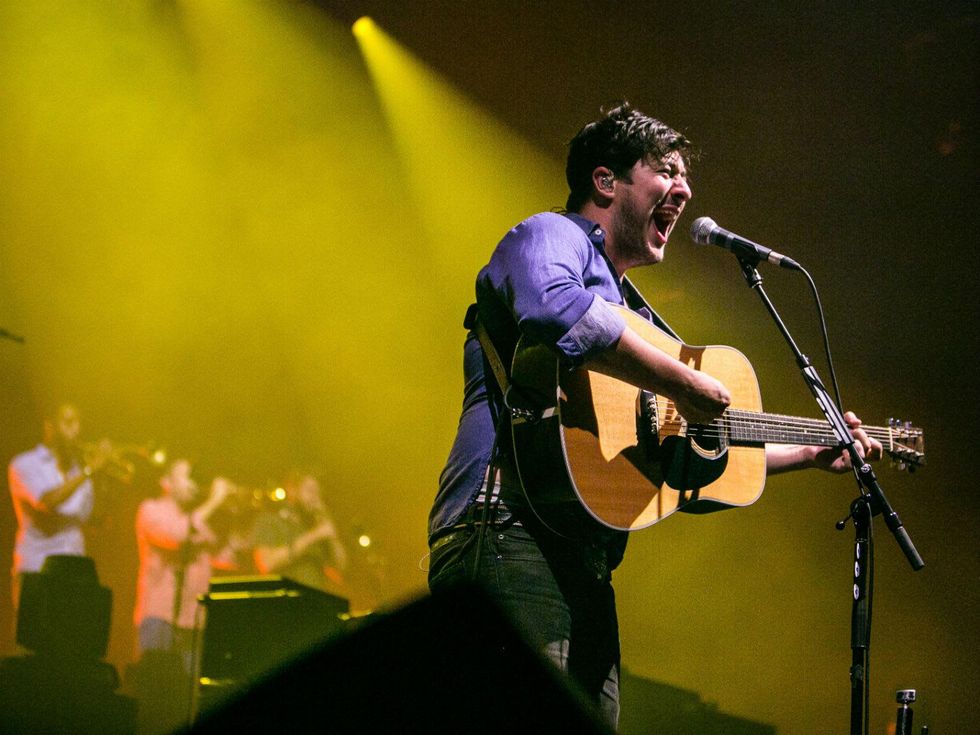
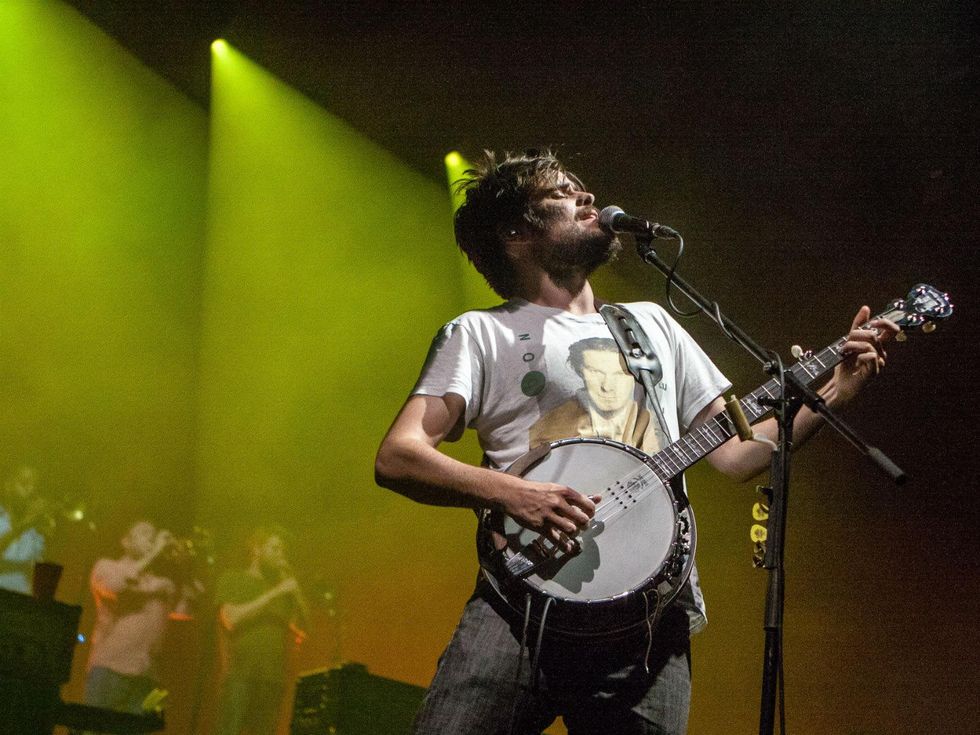
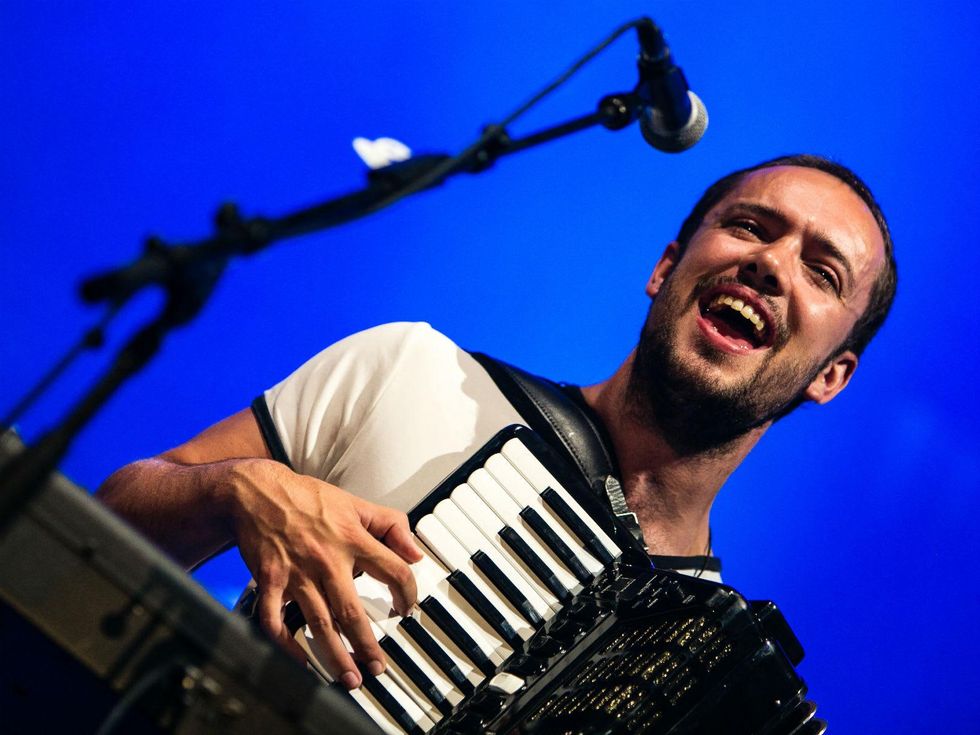
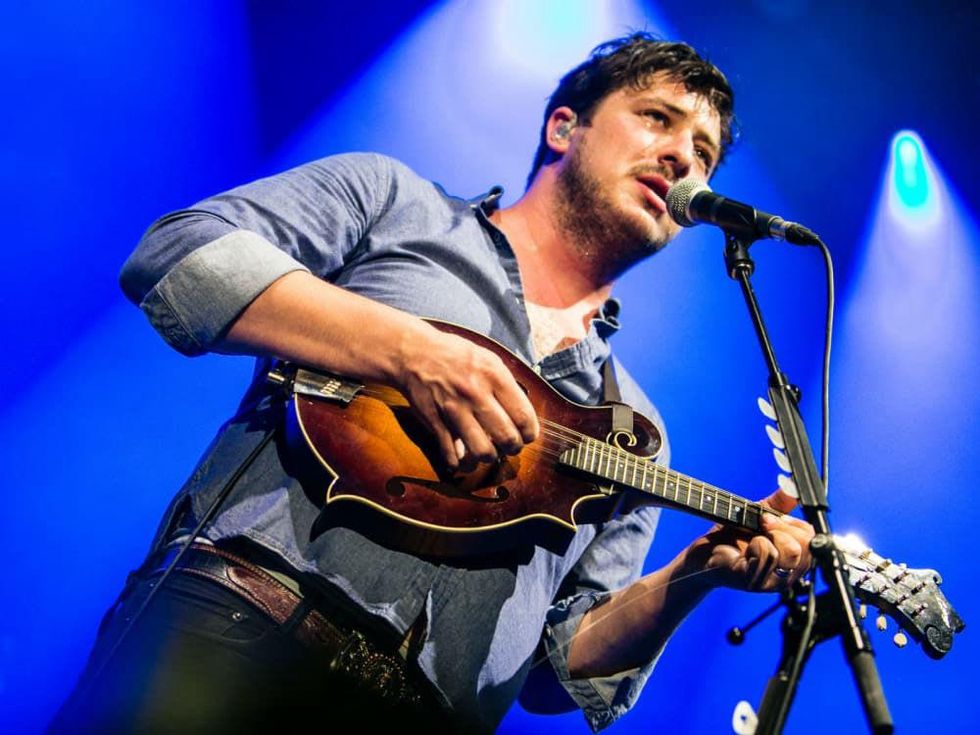
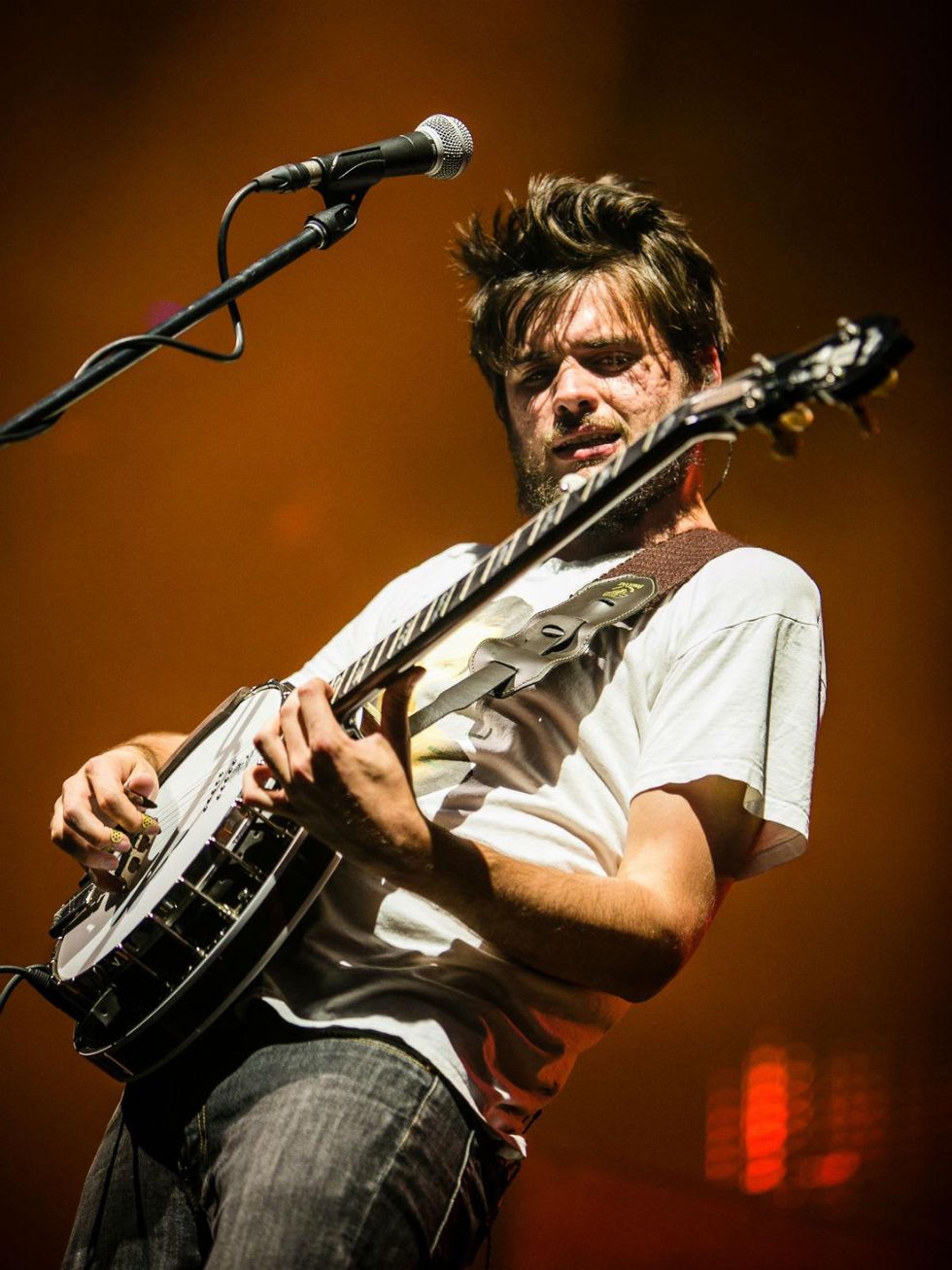
Dallas waited three long months to see English folk rockers Mumford & Sons, who finally hit the stage at Gexa Energy Pavilion September 18. The band had to postpone its June appearance when bassist Ted Dwane underwent surgery for a blood clot on his brain.
Thankfully, Dwane made a swift recovery, and the foursome made good on their promise to return for performance that had the fans on their feet for the duration — at the request of bandmember Ben Lovett, just before they launched into mega-hit "I Will Wait." Pretty young girls bedecked with hippie-like headbands and fringed crocheted vests and many a bearded gent showed their adoration for the chart-topping group that prompted a full-on pop grass movement.
Lovett was also eager to thank the fans for their patience and declared the evening one of "pure celebration." Lead singer Marcus Mumford broke from his soulful, almost sad expression a few times to flash that winning smile and crack a few jokes. "There are so many things I want to say about Texas," he declared as the crowd erupted in cheers.
But the night wasn't always a foot-stomping affair. During the encore, the band huddled around a single mic, asked the crowd to hold their "whoopin' and hollerin' until after," and demonstrated the full breadth of their musical and vocal talents.
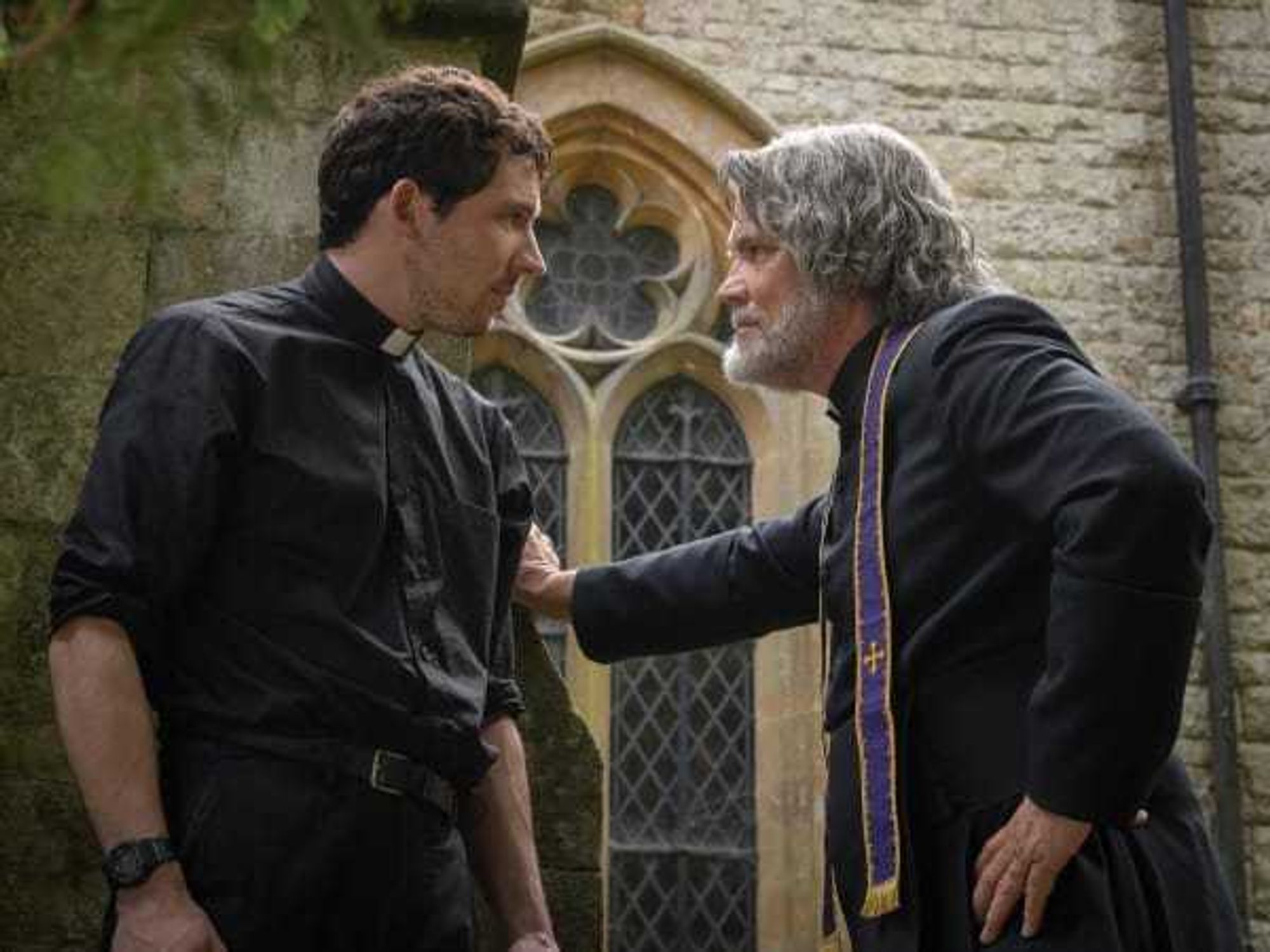
Josh O'Connor and Josh Brolin in Wake Up Dead Man: A Knives Out Mystery.
Since 2019, writer/director Rian Johnson has essentially turned over his career to murder mysteries, including 2019’s Knives Out, 2022’s sequel Glass Onion, and the just-canceled Peacock series Poker Face. He’s back for another bite of the apple with Wake Up Dead Man: A Knives Out Mystery.
While private detective Benoit Blanc (Daniel Craig) returns to help investigate a seemingly impossible murder, the majority of the focus of this film is on the employees and parishioners at a small Catholic church in upstate New York. Father Jud Duplenticy (Josh O’Connor) has been assigned to the parish to work under Monsignor Jefferson Wicks (Josh Brolin). Wicks is a fiery orator who relies on intimidation, as well as the help of church aide Martha Delacroix (Glenn Close), to maintain control over his flock.
That group includes lawyer Vera Draven (Kerry Washington), her politically ambitious brother Cy (Daryl McCormack), Dr. Nat Sharp (Jeremy Renner), writer Lee Ross (Andrew Scott), cellist Simone Vivane (Cailee Spaeny), and groundskeeper Samson Holt (Thomas Haden Church). The tenets of Catholicism, and religion in general, are put to the test as Father Jud challenges Monsignor Jefferson for leadership, and a death changes things even further.
The free-wheeling and fun nature of the first two Knives Out films gives way to a more methodical and introspective approach in Wake Up Dead Man. While Johnson is interested in presenting a murder mystery, it’s the lives of the various characters that take precedence, especially that of Father Jud. He is shown from the start as someone who wrestles with his faith, which is tested on multiple occasions as he encounters people who challenge him more than expected.
The arrival of Blanc on the scene turns the film into a type of buddy movie, with Father Jud serving as both investigator and suspect. Neither man embodies the type of behavior one might expect out of their respective professions, and what limited comedy the film has comes from their interactions. They’re reined in by Police Chief Geraldine Scott (Mila Kunis), although her desire to get to the bottom of the murder is somewhat stymied by Blanc and Father Jud’s diversions.
The lessons learned from two very different types of sources - mystery novels and Catholicism - collide over the course of the film. A book club that very coincidentally includes multiple mystery novels, including John Dickson Carr’s The Hollow Man, plays a key role, as does the devoutness of the various people at the church. Ultimately, as was the case in the first two films, the nature of the whodunit comes in second place to how the characters react to the multiple reveals along the way.
Craig seems to tone down the over-the-top way he usually plays Blanc in this film, and his performance fits in well with the story being told. O’Connor, a star on the rise after Challengers and more, is asked to carry the film and he does so ably. The strong actors in the supporting cast are not used as well as they could have been, with only Close and Brolin truly making an impact. Geoffrey Wright shows up in a couple of small scenes and makes his presence known quickly.
Wake Up Dead Man is the least entertaining Knives Out film so far, but that’s not to say that it’s uninteresting. Johnson explores topics that result in more talking than action, but those conversations - especially between Blanc and Father Jud - are consistently engaging and revelatory about the characters and the crime they are investigating.
---
Wake Up Dead Man: A Knives Out Mystery is now playing in select theaters; it debuts on Netflix on December 12.