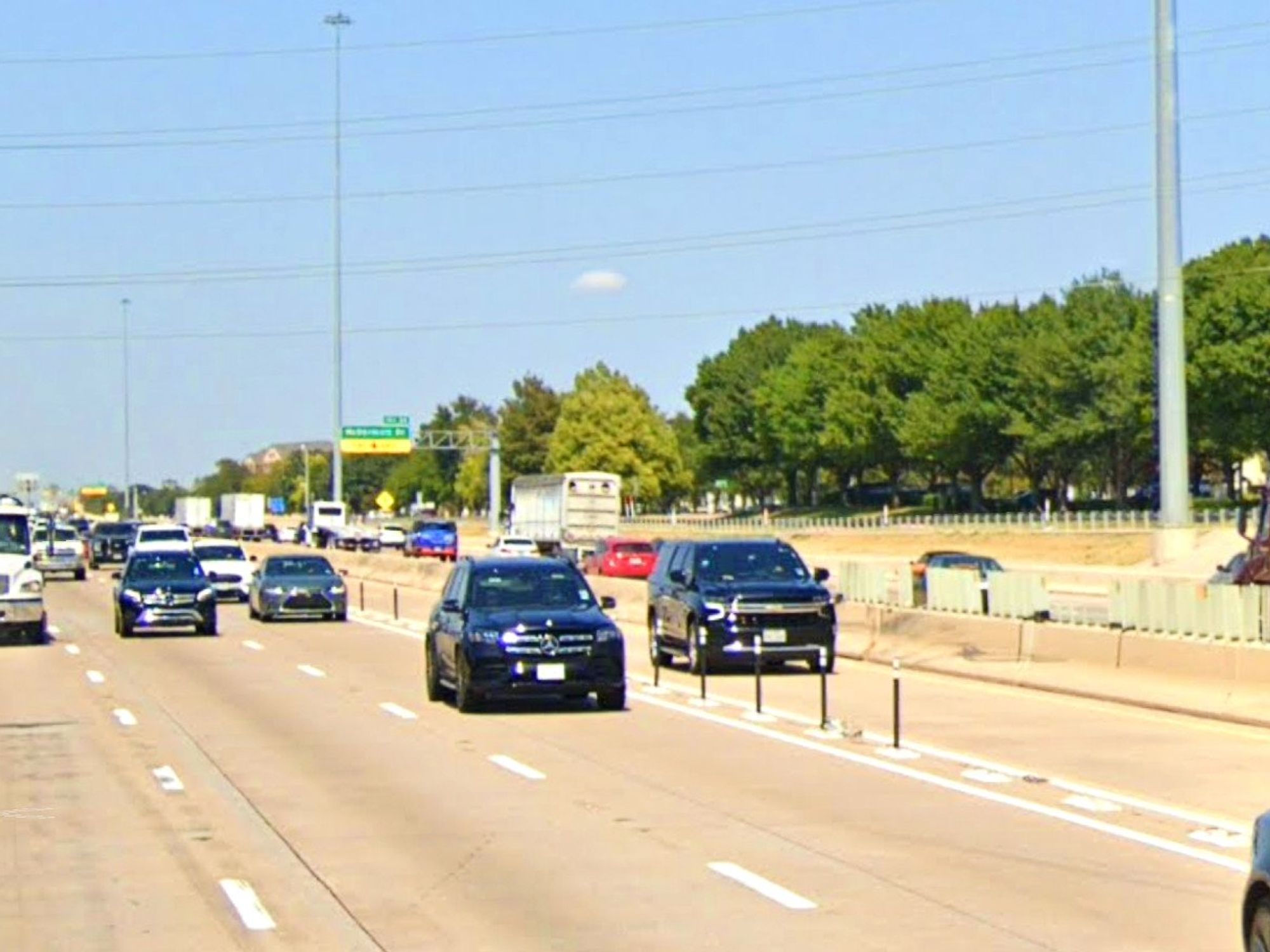
As North Texans hit the road for Thanksgiving, a new analysis of state crash data finds Dallas County is the most crash-prone stretch of two of Texas’ busiest interstates.
Between Thanksgiving week and the first few days of January over the past five years, Dallas County logged 79 crashes that killed or seriously injured someone on just two freeways, the study shows. Of those, 46 happened on Interstate 35E and 33 on Interstate 30. No other Texas county had more serious holiday crashes along I-30 or anywhere on I-35, including the Austin and San Antonio areas.
Sugar Land-based law firm Lone Star Injury Attorneys analyzed the data, ranking 10 Texas interstate corridors by how often severe crashes happened on them during the holiday travel season. I-30 ranked No. 2 statewide and I-35 ranked No. 3.
Grim numbers for I-30 and I-35
On I-30, Dallas County dominates the numbers: 33 of the corridor's 78 severe holiday crashes, or about 42 percent, happened there. Along the full route, 23 people were killed in holiday crashes over five years.
I-35, counting both I-35E through Dallas and I-35W through Fort Worth, logged 213 severe holiday crashes, the most of any interstate in the study. Its 68 holiday deaths were also the most of any Texas interstate.
Fort Worth has its own hotspot.
Tarrant County was the worst stretch of fifth-ranked I-20, with 28 of the corridor's 139 severe holiday crashes. Thirty-seven people were killed in holiday crashes along the full I-20 corridor.
Houston’s I-45 tops the list
Statewide, I-45 ranked as the most dangerous corridor for holiday travel, and Houston is where it's at its worst.
Harris County accounted for 73 of the road's 148 severe holiday crashes over the past five seasons, nearly half the total. That works out to about 15 serious or deadly crashes per holiday season on the Gulf and North freeways, or roughly one every three days.
Along the full route, 41 people were killed in holiday crashes over five years.
I-45 also stands out for another reason. It was one of only two corridors in the study, along with I-27 in the Lubbock area, where severe crashes per day were higher during the holidays than during the rest of the year, though by only 1.5 percent.
Harris County was also the worst stretch on two other interstates. On I-10, it accounted for 47 of the corridor's 177 severe holiday crashes, mostly along the Katy and East freeways. On I-69, it accounted for 17 of 35, along the Eastex and Southwest freeways.
All told, Harris County logged 137 severe holiday crashes on those three corridors, compared with 79 on Dallas County's stretches of I-35E and I-30.
How the study worked
The analysis looked at crash records from the Texas Department of Transportation, covering holiday seasons from 2021 through 2025. The holiday window ran from the Wednesday before Thanksgiving through January 2, or about 40 days per year.
Only the most serious crashes counted — those in which someone was killed or suffered what authorities recorded as a suspected serious injury on a highway's main lanes or ramps. Frontage roads were excluded.
Corridors were scored based on crashes per mile of road, crashes relative to how much traffic each road carries, and how the holiday crash rate compared with the rest of the year.
Dangerous year-round, not just during the holidays
The study comes with an important caveat: Across all 10 corridors, serious crashes were actually 10.6 percent less frequent per day during the holidays than during the rest of the year.
That held true on the DFW routes, too. According to the study's figures, I-30, I-35 and I-20 all saw fewer severe crashes per day during the holidays than at other times. Only I-45 and I-27 bucked the trend.
In other words, the study shows where serious crashes concentrate when Texans pile onto the highways for holiday trips. On I-35E and I-30, that's Dallas County. On I-45, I-10 and I-69, it's Harris County.
“With many people covering longer distances to visit family and friends during Thanksgiving and Christmas, basic safety habits become even more important,” Maxwell Paderewski, an attorney with Lone Star Injury Attorneys, said in a release.
He reminded motorists to buckle up, put the phone away, and take regular breaks to avoid drowsy driving.